
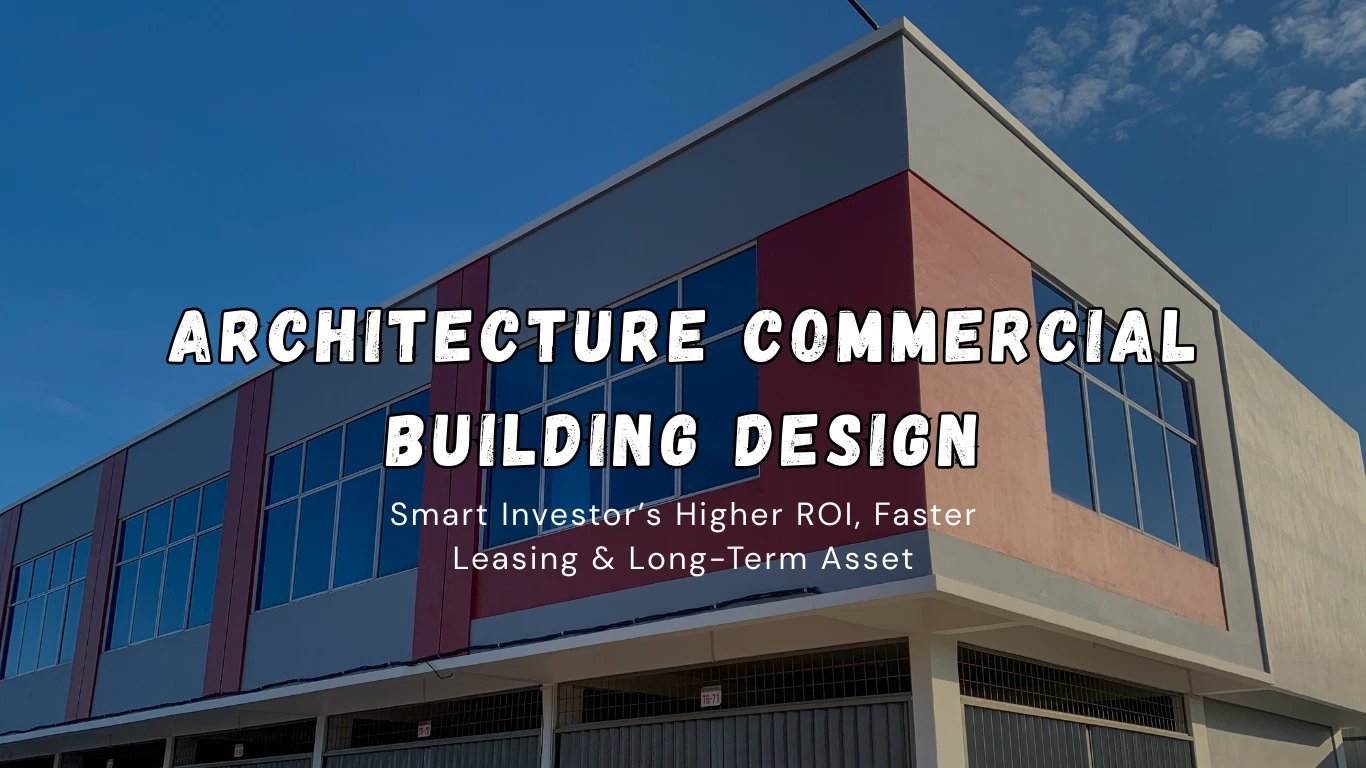
If commercial real estate is your thing, two golden rules would hardly escape you, wouldnt they? Location matters and the numbers dont lie.
But there is a difference between regular investors and high-performing developers:
They, in fact, perceive architecture commercial building design not as just another construction phase, but as their long-term profit strategy.
Besides making a commercial building look good, a well designed one :
Can get higher rent per square foot
Gets premium tenants faster
Vacancy periods are shorter
Operational costs go down
Resale and asset valuation go up
In the present day commercial real estate market, architecture is no longer a matter of choice. It is your competitive edge.
Here is a sneak peek into how good design affects your returns directly :
Why Architecture Is a Profit Multiplier - Not an Expense
One of the first questions from inexperienced investors is :
Why should I invest more in commercial architecture?
Accountants may describe commercial building design as a capital expenditure that adds value through the lifetime of the asset, rather than as an expense.
Cheapest commercial building architects will likely achieve project success based on the financial savings, but this will most probably only be evident in the short term and certain aspects of the success will be sacrificed or compromised.
Some examples of changes a building owner will experience mainly due to the capital expenditure in building architecture are :
Faster leasing
Higher rental income
Longer tenant retention
Lower operating costs
Higher resale value
An increase in Net Operating Income (NOI) can be a direct result of architecture. And it is NOI that determines a propertys value.
How Commercial Building Design Impacts Rental Yield
Consider this from the perspective of an investor.
Two office buildings situated at the same location :
Building A (Poor Design)
72% space efficiency
Limited natural lighting
No smart systems
Outdated facade
Higher energy consumption
Building B (Strategic Architectural Planning)
88% space efficiency
Flexible layouts
Smart HVAC and lighting
Strong brand-oriented facade
Energy-efficient systems
Which one can get a premium rent?
Smart architecture commercial building design increases space optimization. This equates to having more rentable area without any increase in the cost of land.
A 10, 15% efficiency difference alone can lead to a substantial increase in long-term income.
The 6 Architectural Factors That Directly Increase Property Value
1. Efficient Floor Plate Design
Every square foot counts in commercial real estate.
A well-thought-out architectural plan allows:
Space to be used for a minimum of non-productive
Clear circulation paths
Flexible partitioning
If total efficiency increases, the rental income will increase accordingly.
2. Flexible & Future-Ready Layouts
Markets are changing. Tenant demands keep on evolving.
Nowadays, I am a commercial building architect
Leads the way in modular spaces
Provides hybrid office adaptability
Allows retail conversion flexibility
Adaptable construction is the key to a longer life, and happier long-term tenants.
3. Sustainable & Energy-Efficient Design
It is a fact that sustainability brings a financial advantage.
Green commercial buildings provide :
Reduced electricity bills
Reduced water consumption
Less frequent repairs and thus lower costs
Energy-efficient buildings are preferred by tenants as they lead to lower operating costs. On the other hand, investors gain from reduced lifecycle costs and enhanced tenant retention.
4. Smart Technology Integration
Todays tenants are looking for smart buildings.
Features like :
Automated lighting
IoT-based monitoring
Smart HVAC systems
Security automation
They do not only add to the convenience but also help a property to be more attractive in the upscale market.
Smart commercial buildings can get higher rents and also lower the costs of running the operations.
5. Strong Exterior Identity & Facade Design
The outside of the building is what people see first, and therefore the very first indication of the property.
In the case of retail and office location, the first five senses especially influenced by architecture are :
Number of people coming in
How people view the brand
Decisions of leasing executives from corporations
A unique or high-end exterior will increase the value and the demand for the property.
6. Location-Oriented Site Planning
Whether the commercial real estate will be successful or not is largely determined by the consideration of location in the architectural design.
Great design takes full advantage of :
Being seen
Entry points
Parking layout
Foot traffic
A thoughtful site plan really drives up the potential of the business. This is particularly true for retail plazas and mixed-use developments.
Architecture & Risk Management in Commercial Real Estate
One of the first things that come to an investors mind is that the risk is only from the market fluctuations.
However, design-related risks can be :
Compliance issues
Structural planning not up to standard
Utilities that are not efficiently planned
Limited expansion capacity
High maintenance cost
Professional commercial architecture services help to minimize financial risk over the long run by making sure that the project adheres to the rules and is technically efficient.
Simply : A good plan made today will prevent huge losses in the future.
Commercial Architecture Trends Investors Should Watch (2026 & Beyond)
Real estate developments usually have a lifespan of over two decades. Here are some of the ways that commercial real estate is being influenced by common trends:
1. Mixed-Use Developments
By combining retail, office, and residential spaces, the profitability of the land increases.
2. Net-Zero Energy Commercial Buildings
The low cost of effective operations results in the attraction of corporates as tenants.
3. Biophilic & Wellness-Oriented Spaces
The addition of natural light, fresh air, and green spaces helps employees to be more productive and thus attracts other businesses.
4. Experience-Driven Retail Architecture
Retail store architectures are changing to become more experiential rather than just outlets for selling merchandise.
5. Data-Driven Smart Buildings
Use of AI in automatic monitoring for efficiency and predictive maintenance.
Those investors that gear themselves up with matching the pace of architecture will do better than the traditional developers.
Cost vs Value How Smart Investors Evaluate Commercial Design
Beware of focusing only on building cost per square foot. In fact, other aspects that should be
Lifecycle operating cost
Energy efficiency savings
Leasing speed
Tenant turnover rate
Cap rate improvement
Long-term appreciation
Investing 5-8% more in commercial architecture design of high quality may bring in substantially more revenue over a period of 20 years.
The main measure of an asset is its lifetime performance, not merely the construction savings.
Architecture & Tenant Psychology
People who rent do not merely rent a place.
They put their money into a living space
Corporate clients consider :
Natural light
Air flow
Efficiency in using the space
Building technology
Environmentally friendly features
On the other hand, retail tenants look at :
Exposure
Traffic
Ease of access
Ways to showcase the brand
Architecture strongly affects the way people perceive things. And perception, in turn, influences the level of rent.
How to Choose the Right Commercial Architecture Partner
When you plan commercial real estate project, you should
look at an architects track record of commercial projects
consider experience in your particular property type (office, retail, industrial)
judge their understanding of ROI and developer goals
appraise their knowledge of sustainable commercial design
evaluate their capability to incorporate smart building technology
Go for people who get investment metrics, besides just the art of the thing.
The Long-Term Impact of Smart Architecture on Asset Appreciation
Income generation remains a fundamental factor in determining the value of commercial real estate.
Architecture that results in :
Higher rental rates
Longer tenant retention
Greater building efficiency
Will thus, lead to an increase in the propertys valuation
The top-tier designed commercial buildings in highly competitive markets tend to increase in value at a quicker rate when compared to the typical buildings.
The difference is not merely cosmetic, it is financial.
Final Thoughts
As a real estate investor or developer, you are not only trying to make a point by constructing a building.
What you really want is to :
Create a high performing asset
Make a residual income
Have a property which will be appreciating at the long run
Establish commercial space which dominates market
Architecture commercial building design is the basis of that success.
The most knowledgeable and wise investors realize this :
Location will bring you a chance.
Design will be the source of your profit
So if you are going to the next commercial development, dont consider it just a construction.
Consider it as an investment, the next step of your business, the preservation of the environment and the great performance for the long term.
Because in commercial real estate the building you design today determines the returns you will get tomorrow.
No comments yet. Be the first!