
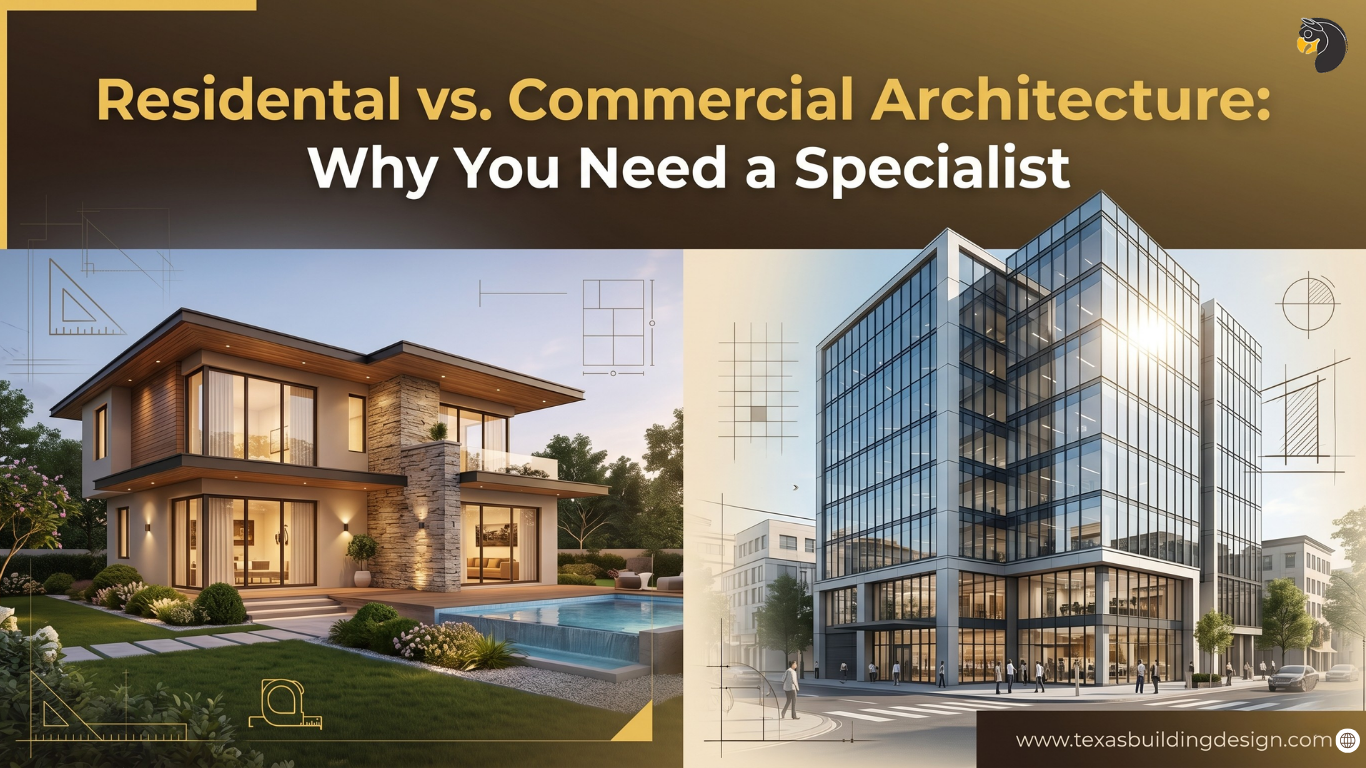
Not all architects are created equal. The skills, codes, regulations, and creative thinking required to design a stunning custom home in Dallas are fundamentally different from those needed to bring a high-performance commercial office or retail space to life. Choosing the wrong specialist can cost you time, money, and your vision.
The Hidden Divide in Architecture
When most people think of an architect, they picture someone who designs buildings. Thats true - but it is a bit like saying a surgeon is someone who operates on people. A cardiologist and a neurosurgeon are both surgeons, yet you would never swap one for the other.
The same principle applies to residential and commercial architecture. While both disciplines require design expertise and engineering knowledge, they serve fundamentally different purposes, operate under different regulations, and demand different problem-solving frameworks. Here in Dallas, TX - one of the fastest-growing metros in the country - getting this distinction right can determine whether your project becomes an enduring asset or an expensive headache.
What Is Residential Architecture?
Residential architecture focuses on designing spaces where people live - custom homes, townhomes, accessory dwelling units, multi-family residences, and home renovations. At its core, residential design is deeply personal. It shows a family's lifestyle, values, and their taste through a physical space that is not only beautiful but functions well every day.
Here is what Residential Architects typically focus on :
- Custom plans creation matching family size and lifestyle
- Residential piece analysis, drainage, orientation, allowable building distance from the road
- Environmentally friendly home design for Texas climate extremes
- Interior design and natural light maximization
- Getting municipal permits and regulatory approvals for residential
- Decide on the materials that look good, last long, and are within the budget
- 3D images and virtual tours before the actual work starts
Residential architects, in Dallas, have to deal with city-specific zoning codes, homeowner association (HOA) rules in the communities that are master-planned, and requirements posed by the Texas climate all the while making your personal vision the top priority.
What is Commercial Architecture?
Commercial architecture refers to the process of designing buildings that are mainly used for business activities such as offices, shops, restaurants, hotels, hospitals, warehouses, and multi-use developments. While residential architectures are mainly a reflection of the owner's personality, commercial architectures should represent the brand, increase efficiency, comply with regulations, and allow future growth.
Here are some fields commercial architects specialize in :
- Making all public areas ADA compliant
- Planning fire exits, determining occupancy loads, and installing life-safety systems
- Structural engineering to support large spans, heavy loads, and open-plan layouts
- Coordination of mechanical, electrical, and plumbing (MEP) at a larger scale
- Developing a brand-consistent exterior and interior design that supports the market positioning
- Obtaining zoning and land-use approve of the authorities for commercial areas
- Producing construction documents that conform to Texas commercial building codes
- Preparing phased construction to avoid business downtime
Key Differences : Residential vs. Commercial Architecture
Lets put it plainly. While both types of architecture share foundational skills, the table below illustrates just how different these disciplines truly are:
| Factor | 🏠 Residential Architecture | 🏢 Commercial Architecture |
|---|---|---|
| Primary Goal | Personal comfort, lifestyle, aesthetics | Business functionality, brand, ROI |
| Building Codes | IRC (International Residential Code) | IBC (International Building Code) + ADA |
| Structural Scale | Light wood framing, modest spans | Steel, concrete, complex load paths |
| Occupancy Rules | Family / limited occupants | Public occupancy — strict fire & egress codes |
| MEP Systems | Residential HVAC, standard plumbing | Commercial HVAC, high-capacity electrical |
| Permitting | City residential plan review | Multi-department review; fire marshal, health, city |
| Timeline | Faster — 6 to 18 months typically | Longer — often 18 months to several years |
| Client Focus | Homeowner / family vision | Stakeholders, investors, brand standards |
| Design Driver | Lifestyle & personal taste | Operational efficiency & market positioning |
Hiring a generalist architect for a specialized project does not save money - it creates costly rework, permit delays, and designs that miss the mark.
- Texas Building Design, Dallas, TXWhy You Need a Specialist - Not a Generalist
1. Building Codes Are Completely Different
This is perhaps the most critical distinction. Residential buildings in Texas are governed by the International Residential Code (IRC). Commercial buildings fall under the far more complex International Building Code (IBC), which includes stringent requirements for fire suppression, structural integrity, accessibility, and occupancy classification.
A residential architect who crosses into commercial territory without this expertise risks costly code violations, failed inspections, and project shutdowns. In Dallas, where the cities Development Services Department enforces these codes rigorously, this is not a risk worth taking.
2. Structural and Engineering Complexity
A beautiful three-bedroom home relies on relatively straightforward light-frame construction. A commercial office building with 40-foot open spans, rooftop mechanical equipment, and underground parking requires entirely different structural engineering — steel frames, reinforced concrete, and deep foundation systems. Commercial architects work hand-in-hand with structural engineers from day one. Many residential architects simply do not have this collaboration infrastructure in place.
3. Permitting Pathways Are Different
In Dallas, the process to get a commercial building permit might need multiple reviews such as the Building Inspection Division, Fire Prevention Bureau, Public Works, Zoning, and even DART may be involved if you're close to light-rail corridors. A specialist commercial architect knows this landscape, prepares complete submission packages, and anticipates reviewer feedback before it causes delays. Residential architects navigating a commercial permit process for the first time can add months to your timeline.
4. ADA Compliance Is Non-Negotiable for Commercial Projects
Any commercial space open to the public must meet ADA requirements - accessible entrances, restroom configurations, parking ratios, signage, and path-of-travel requirements. Failing to design for compliance from the start means expensive retrofits post-construction and potential legal liability. A commercial architecture specialist builds ADA into every line of a drawing.
5. Residential Projects Deserve Human-Centered Design Expertise
On the flip side, a commercial architect handed a residential project may produce a technically sound but sterile home. Residential design requires deep empathy - understanding how a family moves through their home each morning, how natural light affects mood, how a kitchen layout influences the way a household connects. These are skills honed through years of dedicated residential practice.
The Texas Building Design Difference
At Texas Building Design in Dallas, TX, we have dedicated specialist teams for both residential and commercial projects. You would not get a generalist trying to bridge two very different worlds.
- ✔ PELS-approved engineering documentation
- ✔ Texas Board of Engineers recognized firm
- ✔ 10+ years of Dallas-area project experience
- ✔ Full permitting support — city & municipality
- ✔ 3D visualization before a single wall is built
The Dallas Context : Why Local Expertise Matters
Dallas is not a generic city, and Dallas architecture should not be generic either. The DFW metroplex has its own set of unique challenges and opportunities for both residential and commercial projects:
For Residential Projects in Dallas:
- Expansive clay soils require post-tension or pier-and-beam foundations — a local specialist knows this from day one
- HOA design guidelines in communities like Highland Park, Frisco, or Prosper must be respected
- Texas extreme heat means passive solar design and proper roof orientation deliver real energy savings
- Dallas rapid growth means lot sizes and setback rules vary significantly by municipality
For Commercial Projects in Dallas:
- Proximity to major corridors (I-35, I-635, DNT) affects access, parking ratios, and signage
- Dallas mixed-use zoning overlays (like the Uptown or Deep Ellum districts) have specific design guidelines
- Texas summer heat places extraordinary demands on commercial HVAC and building envelope performance
- Stormwater management requirements are stringent in Dallas County
What About Mixed-Use Developments?
Mixed-use projects — buildings that combine residential units above ground-floor retail or office space — are increasingly popular in urban Dallas neighborhoods like Uptown, Oak Cliff, and Lower Greenville. These projects require a firm that genuinely excels at both disciplines simultaneously, since the design must satisfy residential livability on upper floors while meeting commercial code requirements below.
This is exactly the kind of complex, multi-dimensional project where an architecture firm with cross-disciplinary specialist teams — like Texas Building Design — provides the most value. Rather than patching together a generalist with outside consultants, you get an integrated team that speaks both languages fluently.
How to Choose the Right Architectural Specialist for Your Project
When evaluating architecture firms in Dallas for your next project, ask these five questions:
- What is the firms primary specialty? Look for firms that dedicate teams — not just individuals — to either residential or commercial work.
- Can they show comparable completed projects in Dallas? Local experience with the cities permitting, soil conditions, and zoning is invaluable.
- Are they licensed and PELS-approved in Texas? This is a legal requirement for sealed engineering drawings, not optional.
- How transparent is their fee structure? Look for fixed-fee, per-square-foot, or clearly defined percentage-of-project-cost pricing — not vague "TBD" quotes.
- Do they handle permits themselves? A firm that manages the full regulatory approval process saves you weeks of coordination headaches.
At Texas Building Design, we answer "yes" to every one of these questions - and we offer a free initial consultation so you can verify it for yourself before committing to anything.
Conclusion: Specialization Is the Foundation of Great Architecture
Whether you are building your dream home in a Dallas suburb or developing a commercial property that will anchor a neighborhood for generations, the architecture discipline you need is a specialty, not a generality. The codes are different. The structural demands are different. The human needs being served are different.
Hiring a specialist is not about paying more - it is about paying once. The right architect gets it right the first time: the permits sail through, the structure performs, and the space actually does what you need it to do for years to come.
Texas Building Design has spent over a decade becoming that specialist for both residential and commercial clients across Dallas and the DFW Metroplex. Reach out today for a free consultation and lets talk about what your project actually needs.
No comments yet. Be the first!